
F O O D W A S T E
What is Food Waste?
"The decrease of food in
subsequent stages of the food
supply chain intended for human consumption.”
- Food and Agricultural Organization of the United Nations
What is Food Waste?

Why Do I Care?
Why not? Food is part of everyone’s lives.
We all have to get food from somewhere; luxury 5 star restaurants, convenient fast food chains, or from local food banks. Everyone needs food to survive but it’s become so much more than just substance to keep us alive. It’s become a whole culture within itself. We socialize with food now.
We post Instagram worthy meals on social media like it’s an accessory. Grocery stores are filled with an abundant amount of food that’s always fresh and always in the best shape.
I grew up in the rich part of Northern Virginia. My family shops at Whole Foods, I go to D.C. to eat at trendy cafes and nice restaurants almost every weekend, and I’ve always had plenty of food in the fridge. I never had to deal with food insecurity. I’ve never known anything different until I volunteered at a food bank in middle school.
There were people living in my neighborhood that were struggling with getting food on the table. But that wasn’t the most shocking part.
I saw one of my classmates in line with her family to get a box full of donated food for the week.
We made eye contact and she quickly looked away. She seemed embarrassed and self-conscious. I was filled with shock. I couldn’t stop looking over in her direction. Why is she here? We go to the same rich school, with the same rich friends, and in the same rich district.
I went home that night looking in my fridge and feeling guilty for all the food I had. But the worst part was looking at the all the food that was about to be thrown away because we forgot about it or it expired. My mom would throw away some food every now and then but when I thought about it,the food we threw away would’ve been enough for my classmate to eat for that week.
My whole perspective on food changed
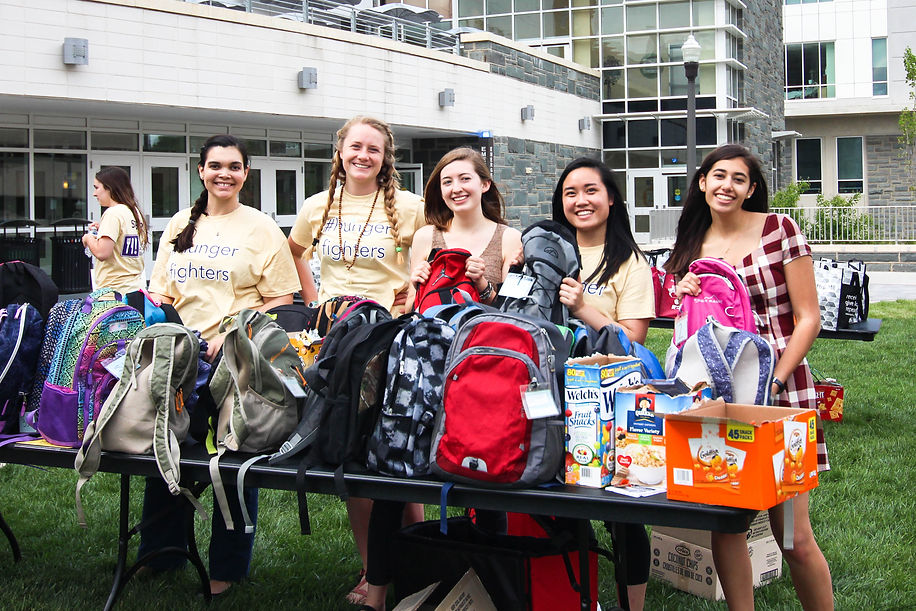
Once I entered college, I joined a student organization called Campus Kitchen that is centered around food waste and hunger in the community. We recover food that could have been wasted on campus and in the community and create healthy meals for food insecure people. I thought that my college town might have fewer people dealing with food insecurity because it’s not a large city but I was wrong.
I didn’t realize that 70% of children in Harrisonburg County Public Schools receive free or reduced lunches.
That’s a shocking amount of children who have no control in where they receive their next meal.
Hunger is everywhere but so is food waste.

America is
Wasting Away
How does America waste nearly 40% of produce a year?
It all comes down to our obsession with perfection. Our culture has fed us into the idea that if it’s not “blemish-free” then it’s not good enough and must be rejected. We’re conditioned this way by going into grocery stores where the produce and meat are all packaged and stacked neatly. There seems to be an incredible abundance of perfectly produced food to choose from.
We don’t normally see the process of how companies grow, harvest, process, and package the food for us. Food companies would never advertise that 72 billion pounds of food within the processing cycle is rejected each year.But food companies aren’t the only ones wasting. Consumers throw away 52 billion pounds of food or $218 million every year. And where does all this food end up?

L A N D F I L L S
About 21% of landfills are made up of food.
Throwing away this much food doesn’t just take up space in landfills, it also has a drastic effect in our environment. The food that’s thrown away and rots produces CO2. This is a greenhouse gas that effects global warming. It is estimated that 3.3 gigatons of CO2 is admitted from food waste. That makes...

A clip from the documentary Wasted that highlights the immense amount of food wasted around the world.

College Student Impact
As a college student, I wanted to know how universities play a roll in American food waste. I became even more curious after joining Campus Kitchen. I had to create an infographic for them so I researched food waste on college campuses.
I discovered that the average college student throws away about 142 pounds of food every year.
That’s a crazy amount to think about since most people aren’t conscious about what they throw away.
But it isn’t just students doing all the wasting. If we added up what college campuses across the United States throw away you would be wasting about 22 million pounds of uneaten food per year. National food safety regulations require food to be thrown away if it has been out of temperature for too long or has even been touched only with a serving spoon. This makes it difficult for schools to donate any leftover food at the end of day. Especially with dining halls that have an abundance of food that has been served all day.

We’re all wasting some amount of food. But have you ever thought of the privilege you may have by throwing food away?
I have worked at several soup kitchens and homeless shelters that serve donated food to those in need. And seeing the drastic difference of the food an average college student receives vs. a person coming in for a donated meal is shocking.
Photo Comparisons of a College Dining Hall and a Soup Kitchen
Front: James Madison University Festival Dining hall
Back: Harrisonburg Salvation Army Shelter
Front: Inside the Dining Hall
Back: Inside the Shelter
Front: Unlimited amount of plates served at Dining Hall
Back: Single plate served at Shelter

N O W W H A T?
THE NEXT STEPS IN ENDING FOOD WASTE
Start your own Campus Kitchen at your school today!

Watch this video to learn tips on how to reduce food waste